Ringkas artikel ini ke dalam bahasa Indonesia yang jelas dan formal maksimal 120-150 kata:
The lesson looked great on the surface.
Students were on task. Materials were moving. Directions were being followed step by step.
But something felt off.
No one was stuck.
No one was asking questions.
No one was thinking.
That’s the moment you realize: the problem isn’t engagement. The task is too easy.
That’s the moment you realize: the problem isn’t engagement. The task is too easy.
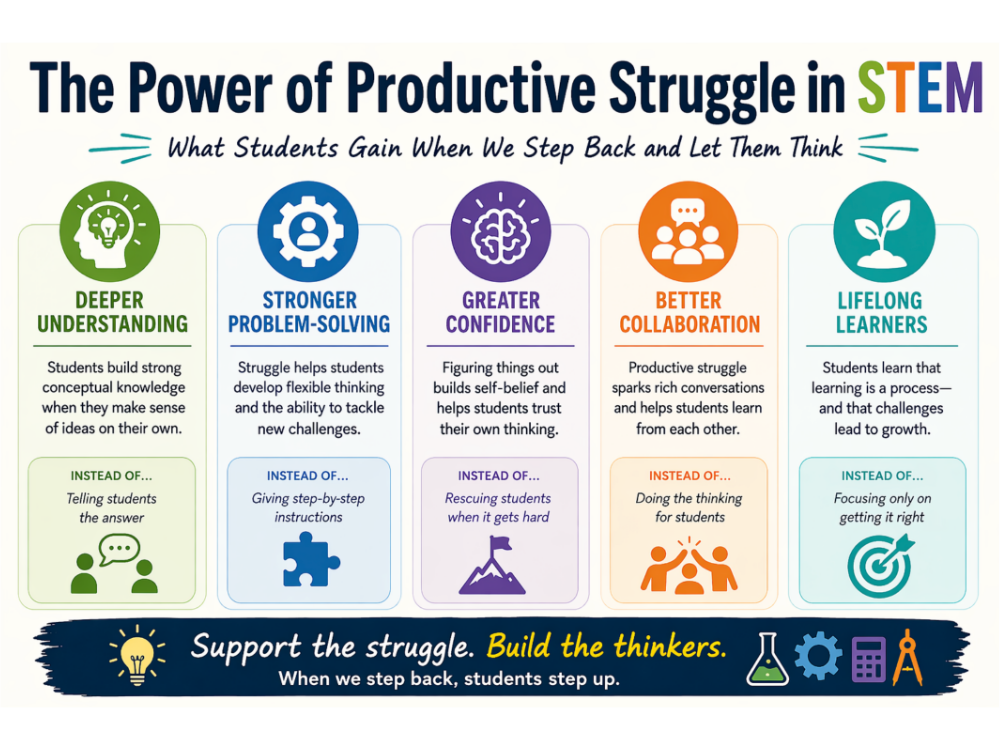
When STEM Tasks Miss the Mark
Too Easy
- Follow steps.
- No decisions.
- Fast finish.
- “Is this right?”
Just Right
- Makes decisions.
- Productive struggle.
- Tests ideas.
- “What if…?”
Too Hard
- Confused quickly.
- Stuck early.
- Gives up.
- Needs constant help.
Most classrooms don’t land in the middle by accident.
When everything is scaffolded, nothing is figured out.
The Real Problem
We’ve been trained to value engagement. If students are busy, we assume learning is happening.
But busy doesn’t mean thinking.
A student can follow directions perfectly and still avoid making a single decision. That’s not learning, that’s compliance.
When everything is scaffolded, nothing is figured out.
Why This Happens
It usually comes from a good place.
- We want students to feel successful.
- We break tasks into clean, manageable steps.
- We give help early to prevent frustration.
- We model the “right way” too soon.
Before long, the lesson runs smoothly. Too smoothly.
Like bowling with bumpers. You can’t miss, but you’re not really playing either.
5 Signs Your Lesson Is Too Easy
If students don’t have to think, they won’t.
1. Students finish quickly with no friction
They move fast. They check boxes. They’re done before you expect it. Speed replaces thinking.
2. Every student produces the same result
Same design. Same answer. Same process.
That’s not creativity. That’s copying work with confidence.
3. Students ask, “Is this…
![Tulis ulang artikel berikut ke dalam bahasa Indonesia yang rapi, mudah dipahami, gaya formal pendidikan, minimal 300 kata:
From Screen To World: 5 Ways To Use AI To Spark Hands-On Learning In K–12 Classrooms
contributed by Athena Stanley
Artificial Intelligence (AI) has the potential to be a powerful tool for student learning when paired with strong foundations in ethics, integrity, data privacy, bias awareness, and the ability to detect misinformation.
When used thoughtfully, AI can support brainstorming, revision, coaching, and feedback.
At the same time, many educators remain cautious. Concerns about overreliance, reduced critical thinking, academic dishonesty, and increased screen time are valid and worth addressing. Students need opportunities to interact face-to-face, engage with real-world contexts, and develop as whole learners beyond digital environments.
Yet reducing screen time does not require removing AI altogether.
In fact, AI is most powerful not when students remain on the screen, but when it launches them into real-world thinking, creating, and doing. The goal is not to keep students using AI, it is to use AI to move them beyond it.
Below are five practical, classroom-ready strategies that use AI as a launch point for hands-on, off-screen learning. The example prompts can be adapted by teachers to reflect their specific context, grade level, and learning goals.
1. Innovation Challenge
Provide students with a set of physical materials to explore individually or in groups. Students take a photo of the materials and ask AI to generate an innovation challenge based on what they see.
This approach encourages creativity, problem-solving, and experimentation. Prompts can be tailored to include specific learning objectives, such as forming a hypothesis, testing ideas, or presenting a final solution from the perspective of an inventor.
Example AI Prompt:
I am a [grade] student. I will upload a photo of materials I have. Based on these materials, create an innovation challenge for me.Include:
A clear goal
A requirement to... Sumber: Baca selengkapnya](https://jazuli-rahman.my.id/wp-content/uploads/2026/04/1776818021_Tulis-ulang-artikel-berikut-ke-dalam-bahasa-Indonesia-yang-rapi.png)