Advertisement
Tulis ulang artikel berikut ke dalam bahasa Indonesia yang rapi, mudah dipahami, gaya formal pendidikan, minimal 300 kata: 


contributed by Meg Price, the ei experience


Social-emotional learning (SEL) by definition is a process for learning life skills, including how to deal with oneself, others, and relationships, and work in an effective manner.


Although there are many great SEL programs, SEL can also be incorporated into each lesson as a way of teaching students to understand how to action the skills in a variety of situations and form positive habits. All students start school with some level of social and emotional skills, and all will develop their social and emotional skills at different rates.


Parents and teachers are both responsible for teaching students life skills, and certainly, much of what they learn will be by watching our actions. The five strategies below are will not only benefit students’ social-emotional learning, but can also be beneficial to teachers’ well-being, too.


See also The Benefits Of Social-Emotional Learning


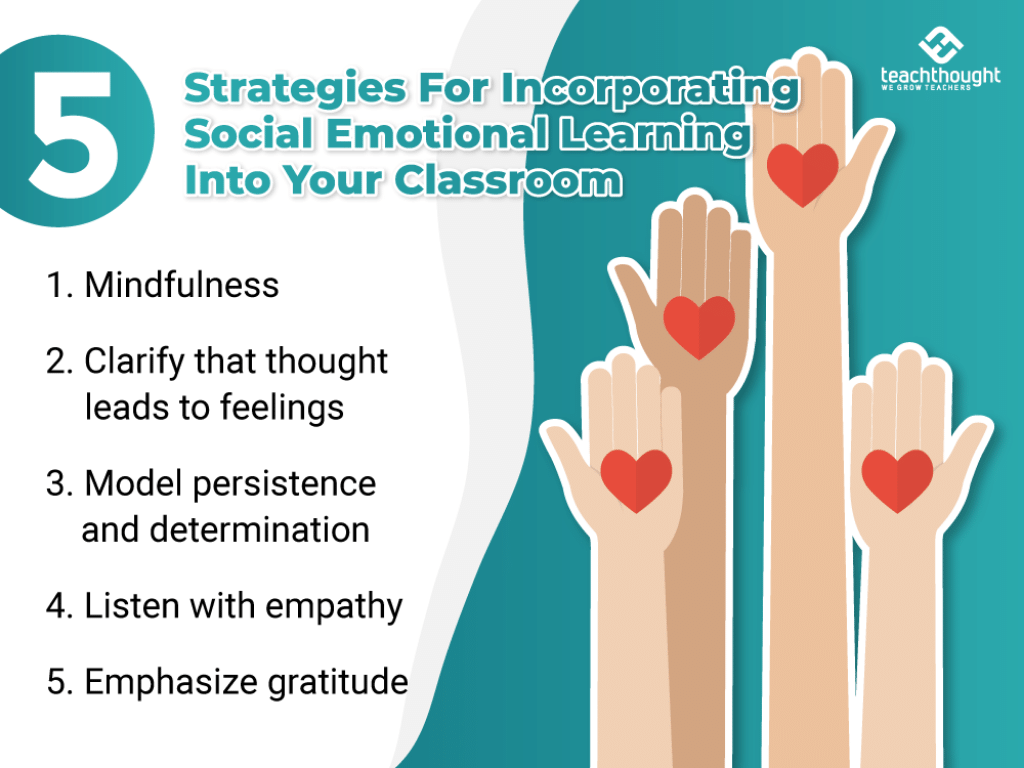
5 Strategies For Incorporating Social-Emotional Learning Into Your Classroom 


1. Through mindfulness


Mindfulness is: paying attention, in a particular way, on purpose, in the present moment, non-judgmentally.


We are hearing more and more about the benefits of mindfulness for children. Increased attention leads to better performance academically and increased emotional and social intelligence. Children are better able to learn, nurture themselves, and be aware of their own emotional needs.


Mindfulness practices help students focus on their breath, body, thoughts, feelings, and the world around them. When they can observe their thoughts and feelings, they have the freedom to choose how they will speak and act–which can lead to a happier, more harmonious classroom.


There are many mindfulness activities available for free–on YouTube, for example. Further, there are mindfulness and meditation apps that can provide frameworks for getting started. Why not start each lesson with a different mindfulness...   Sumber: Baca selengkapnya

Tulis ulang artikel berikut ke dalam bahasa Indonesia yang rapi, mudah dipahami, gaya formal pendidikan, minimal 300 kata:

contributed by Meg Price, the ei experience

Social-emotional learning (SEL) by definition is a process for learning life skills, including how to deal with oneself, others, and relationships, and work in an effective manner.

Although there are many great SEL programs, SEL can also be incorporated into each lesson as a way of teaching students to understand how to action the skills in a variety of situations and form positive habits. All students start school with some level of social and emotional skills, and all will develop their social and emotional skills at different rates.

Parents and teachers are both responsible for teaching students life skills, and certainly, much of what they learn will be by watching our actions. The five strategies below are will not only benefit students’ social-emotional learning, but can also be beneficial to teachers’ well-being, too.

See also The Benefits Of Social-Emotional Learning

5 Strategies For Incorporating Social-Emotional Learning Into Your Classroom

1. Through mindfulness

Mindfulness is: paying attention, in a particular way, on purpose, in the present moment, non-judgmentally.

We are hearing more and more about the benefits of mindfulness for children. Increased attention leads to better performance academically and increased emotional and social intelligence. Children are better able to learn, nurture themselves, and be aware of their own emotional needs.

Mindfulness practices help students focus on their breath, body, thoughts, feelings, and the world around them. When they can observe their thoughts and feelings, they have the freedom to choose how they will speak and act–which can lead to a happier, more harmonious classroom.

There are many mindfulness activities available for free–on YouTube, for example. Further, there are mindfulness and meditation apps that can provide frameworks for getting started. Why not start each lesson with a different mindfulness…


Sumber: Baca selengkapnya

Ringkas artikel ini ke dalam bahasa Indonesia yang jelas dan formal maksimal 120-150 kata: contributed by Meg Price, the ei…

Read More
Tulis ulang artikel berikut ke dalam bahasa Indonesia yang rapi, mudah dipahami, gaya formal pendidikan, minimal 300 kata:

Classroom Management Strategies

Classroom management strategies are the deliberate actions teachers use to organize learning conditions so students can participate productively. Effective management depends on how teachers build relationships, establish routines, design tasks, and respond to behavior in real time.

1. Relationship Building as a Classroom Management Strategy

Relationship building functions as a classroom management strategy because students are more likely to follow direction and remain engaged when they perceive the classroom as fair and predictable. Research has linked teacher-student relationships to improved behavioral and academic outcomes (Hamre & Pianta, 2001).

Strategies that develop this approach

Use targeted acknowledgment
Replace general praise with brief, specific feedback tied to effort or decision-making.

Build short, consistent interactions
Use transitions or independent work time for brief check-ins with individual students.

Structure participation to reduce social risk
Use partner or small-group structures before whole-class discussion.

2. Establishing Routines as a Classroom Management Strategy

Establishing routines reduces ambiguity and prevents repeated correction. Effective classrooms rely on explicitly taught procedures rather than assumed habits (Evertson & Emmer, 1982).

Strategies that develop this approach

Teach entry and start-of-task behavior
Begin each class with a consistent opening task.

Use visible cues for transitions
Post brief step sequences for common routines.

Re-teach routines when breakdown occurs
Pause and model again instead of repeating directions.

3. Task Design as a Classroom Management Strategy

Task design influences behavior. When work is unclear or mismatched in difficulty, students disengage or…


Sumber:
Baca selengkapnya

Ringkas artikel ini ke dalam bahasa Indonesia yang jelas dan formal maksimal 120-150 kata: Classroom Management Strategies Classroom management strategies…

Read More
Tulis ulang artikel berikut ke dalam bahasa Indonesia yang rapi, mudah dipahami, gaya formal pendidikan, minimal 300 kata: 


contributed by Dr. Athena Stanley


Artificial intelligence is increasingly present in education conversations. Some teachers are experimenting with it. Others are cautious. Many are simply unsure where it belongs or whether it belongs at all.


A recent Gallup poll found that three in ten teachers use AI weekly, with findings indicating improvements in the quality of certain tasks. The study also estimated that AI-supported work could amount to the equivalent of approximately six weeks of time saved over the course of a year. 


Meanwhile, a RAND study found that more than half of students and teachers report already using AI in school contexts, even as formal guidance and policy have struggled to keep pace. 


Amid concerns about plagiarism, bias, and the potential impact on students’ critical thinking skills, uncertainty is understandable. The question, then, may not be whether AI exists in education, but where it meaningfully fits within curriculum and assessment.


In some classrooms or contexts, integration may be limited in scope and highly intentional, emphasizing critical examination rather than routine or active use.


Several instructional domains offer starting points for this reflection. Rather than positioning AI as a solution or a threat, educators might consider how, and whether, it aligns with their instructional goals, assessment practices, and professional values.


1. Curriculum Planning and Lesson Design


Curriculum planning is one area where AI may intersect with teacher workflow, particularly during early stages of lesson design or brainstorming. Teachers may feel overwhelmed by the task, have too many ideas competing for attention, or be looking for ways to refresh familiar approaches. AI may help ease this “blank page” pressure by offering general overviews or serving as a brainstorming partner.


AI may also support more specific elements of lesson and unit planning, such as identifying alignment between...   Sumber: Baca selengkapnya

Tulis ulang artikel berikut ke dalam bahasa Indonesia yang rapi, mudah dipahami, gaya formal pendidikan, minimal 300 kata:

contributed by Dr. Athena Stanley

Artificial intelligence is increasingly present in education conversations. Some teachers are experimenting with it. Others are cautious. Many are simply unsure where it belongs or whether it belongs at all.

A recent Gallup poll found that three in ten teachers use AI weekly, with findings indicating improvements in the quality of certain tasks. The study also estimated that AI-supported work could amount to the equivalent of approximately six weeks of time saved over the course of a year.

Meanwhile, a RAND study found that more than half of students and teachers report already using AI in school contexts, even as formal guidance and policy have struggled to keep pace. 

Amid concerns about plagiarism, bias, and the potential impact on students’ critical thinking skills, uncertainty is understandable. The question, then, may not be whether AI exists in education, but where it meaningfully fits within curriculum and assessment.

In some classrooms or contexts, integration may be limited in scope and highly intentional, emphasizing critical examination rather than routine or active use.

Several instructional domains offer starting points for this reflection. Rather than positioning AI as a solution or a threat, educators might consider how, and whether, it aligns with their instructional goals, assessment practices, and professional values.

1. Curriculum Planning and Lesson Design

Curriculum planning is one area where AI may intersect with teacher workflow, particularly during early stages of lesson design or brainstorming. Teachers may feel overwhelmed by the task, have too many ideas competing for attention, or be looking for ways to refresh familiar approaches. AI may help ease this “blank page” pressure by offering general overviews or serving as a brainstorming partner.

AI may also support more specific elements of lesson and unit planning, such as identifying alignment between…


Sumber: Baca selengkapnya

Ringkas artikel ini ke dalam bahasa Indonesia yang jelas dan formal maksimal 120-150 kata: contributed by Dr. Athena Stanley Artificial…

Read More
Tulis ulang artikel berikut ke dalam bahasa Indonesia yang rapi, mudah dipahami, gaya formal pendidikan, minimal 300 kata: 
	
Teaching Students to Navigate Common Digital File Challenges


In today’s learning area, working with digital files is an integral part of the educational process. Students create, save, share, and edit various documents every day. 


They can range from simple text files to complex multimedia projects. Meanwhile, with technological progress, many students face challenges that hinder effective learning. That’s why the skill to navigate the digital space is no longer just an extra one.  It must now be a core competency. 


Teaching students to overcome these challenges means not only improving their academic performance. It is also about preparing them for the real world. A place where digital literacy is critically important.


See also 15 Ways To Share Digital Files


Digital File Challenges in Education. 


The first step toward solving the problem is to recognize its scope. Digital file challenges arise due to:


A lack of systematic organization;


Insufficient understanding of file formats;


Incorrect approaches to data storage.


Students often get lost among a large number of documents or cannot find the files they need. They also frequently submit work in the wrong format. In such a context, there is a need to teach not only technical skills. Here appears the need for the logic behind working with files. If a student understands why certain formats are suitable for specific tasks, they can avoid many problems. 


Here it’s a good idea to look into tools that simplify working with file formats. A practical example is when students use images in HEIC format. These may not open on many devices or platforms. In such cases, tools acting as HEIC to PNG converter come in handy. This can allow you to quickly change the file format without losing quality. They also ensure compatibility with most systems. In this way, you can avoid technical issues when submitting assignments. Also, you’ll make the learning process smoother.


Student...   Sumber: Baca selengkapnya

Tulis ulang artikel berikut ke dalam bahasa Indonesia yang rapi, mudah dipahami, gaya formal pendidikan, minimal 300 kata:

Teaching Students to Navigate Common Digital File Challenges

In today’s learning area, working with digital files is an integral part of the educational process. Students create, save, share, and edit various documents every day.

They can range from simple text files to complex multimedia projects. Meanwhile, with technological progress, many students face challenges that hinder effective learning. That’s why the skill to navigate the digital space is no longer just an extra one.  It must now be a core competency.

Teaching students to overcome these challenges means not only improving their academic performance. It is also about preparing them for the real world. A place where digital literacy is critically important.

See also 15 Ways To Share Digital Files

Digital File Challenges in Education. 

The first step toward solving the problem is to recognize its scope. Digital file challenges arise due to:

  • A lack of systematic organization;
  • Insufficient understanding of file formats;
  • Incorrect approaches to data storage.

Students often get lost among a large number of documents or cannot find the files they need. They also frequently submit work in the wrong format. In such a context, there is a need to teach not only technical skills. Here appears the need for the logic behind working with files. If a student understands why certain formats are suitable for specific tasks, they can avoid many problems.

Here it’s a good idea to look into tools that simplify working with file formats. A practical example is when students use images in HEIC format. These may not open on many devices or platforms. In such cases, tools acting as HEIC to PNG converter come in handy. This can allow you to quickly change the file format without losing quality. They also ensure compatibility with most systems. In this way, you can avoid technical issues when submitting assignments. Also, you’ll make the learning process smoother.

Student…


Sumber: Baca selengkapnya

Ringkas artikel ini ke dalam bahasa Indonesia yang jelas dan formal maksimal 120-150 kata: Teaching Students to Navigate Common Digital…

Read More
Tulis ulang artikel berikut ke dalam bahasa Indonesia yang rapi, mudah dipahami, gaya formal pendidikan, minimal 300 kata: 
	
contributed by Mike Brown, education researcher at preppool.


Every educator has seen it.


A thoughtful, engaged student studies diligently, participates in class discussions, completes assignments on time—and then underperforms on the first major assessment.


The disappointment is visible. Sometimes the teacher feels it just as strongly as the student.


The instinctive explanations are familiar: anxiety, distraction, poor time management, lack of effort. But if this pattern repeats across classrooms and grade levels, it may point to something more structural.


What if first-time underperformance is less about student shortcomings and more about how we design learning?


If we look closely, many learning environments unintentionally reward familiarity over retrieval, coverage over coherence, and comfort over cognitive strain. Students leave review sessions feeling confident—only to discover that confidence was built on recognition, not recall.


That distinction matters more than we often admit.


The Gap Between Knowing and Being Able to Retrieve


In most classrooms, preparation looks something like this:


Students reread notes.


They highlight key passages.


They review slides.


They skim summaries.


These activities feel productive. There is visible effort. There is time invested. There is even a sense of clarity while reviewing.


But recognition is not retrieval.


When information is in front of us, it feels accessible. When it isn’t, the experience changes. Exams and performance tasks require students to produce knowledge independently—sometimes under time constraints, sometimes in unfamiliar formats.


The problem is not that students don’t “know” the material. The problem is that they have not practiced retrieving it often enough.


In research work examining exam-readiness behaviors—including analysis conducted by the team at PrepPool studying assessment performance trends—one pattern appears...   Sumber: Baca selengkapnya

Tulis ulang artikel berikut ke dalam bahasa Indonesia yang rapi, mudah dipahami, gaya formal pendidikan, minimal 300 kata:

contributed by Mike Brown, education researcher at preppool.

Every educator has seen it.

A thoughtful, engaged student studies diligently, participates in class discussions, completes assignments on time—and then underperforms on the first major assessment.

The disappointment is visible. Sometimes the teacher feels it just as strongly as the student.

The instinctive explanations are familiar: anxiety, distraction, poor time management, lack of effort. But if this pattern repeats across classrooms and grade levels, it may point to something more structural.

What if first-time underperformance is less about student shortcomings and more about how we design learning?

If we look closely, many learning environments unintentionally reward familiarity over retrieval, coverage over coherence, and comfort over cognitive strain. Students leave review sessions feeling confident—only to discover that confidence was built on recognition, not recall.

That distinction matters more than we often admit.

The Gap Between Knowing and Being Able to Retrieve

In most classrooms, preparation looks something like this:

Students reread notes.

They highlight key passages.

They review slides.

They skim summaries.

These activities feel productive. There is visible effort. There is time invested. There is even a sense of clarity while reviewing.

But recognition is not retrieval.

When information is in front of us, it feels accessible. When it isn’t, the experience changes. Exams and performance tasks require students to produce knowledge independently—sometimes under time constraints, sometimes in unfamiliar formats.

The problem is not that students don’t “know” the material. The problem is that they have not practiced retrieving it often enough.

In research work examining exam-readiness behaviors—including analysis conducted by the team at PrepPool studying assessment performance trends—one pattern appears…


Sumber: Baca selengkapnya

Ringkas artikel ini ke dalam bahasa Indonesia yang jelas dan formal maksimal 120-150 kata: contributed by Mike Brown, education researcher…

Read More