Advertisement
Tulis ulang artikel berikut ke dalam bahasa Indonesia yang rapi, mudah dipahami, gaya formal pendidikan, minimal 300 kata: 


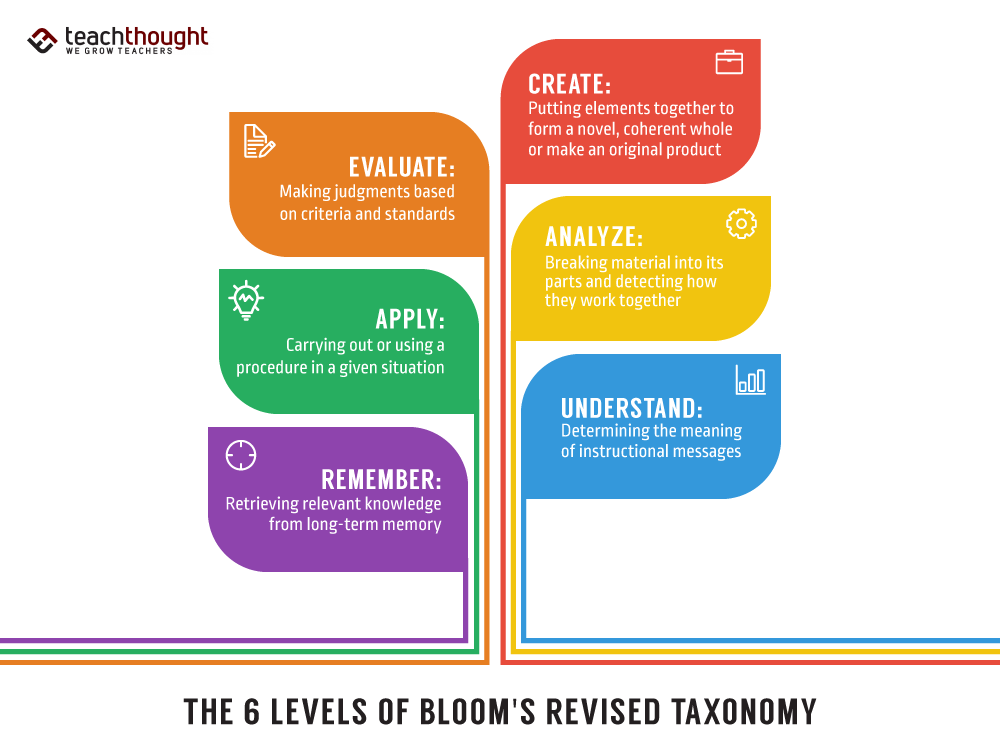
  Bloom’s Revised Taxonomy: cognitive process dimension


Bloom’s Revised Taxonomy changed the original 1956 framework by updating the level names to verbs, reordering the top levels, and adding a second dimension for types of knowledge. The revision clarifies what students do cognitively and how those actions interact with factual, conceptual, procedural, and metacognitive knowledge.


  How Bloom’s Taxonomy Changed
  
    Nouns to verbs: levels reframed as cognitive actions: Remember, Understand, Apply, Analyze, Evaluate, Create.
    Top-level reorder: Create placed above Evaluate to reflect generative thinking.
    Two dimensions: pair the Cognitive Process with the Knowledge Dimension (Factual, Conceptual, Procedural, Metacognitive).
    Clearer alignment: objectives, instruction, and assessment mapped with the Taxonomy Table.
    Modernized language: Comprehension becomes Understand; Knowledge becomes Remember.
    Planning impact: encourages task verbs and evidence of learning rather than category labels.


  Original vs Revised Level Names


        Original (1956)
        Revised (2001)


      KnowledgeRemember
      ComprehensionUnderstand
      ApplicationApply
      AnalysisAnalyze
      SynthesisCreate
      EvaluationEvaluate


  What Changed Beyond the Words
  
    The revision introduced the Taxonomy Table: a grid that crosses six cognitive processes with four knowledge types. This helps teachers specify outcomes and assessments more precisely, for example, Analyze x using conceptual knowledge or Apply y using procedural knowledge.
  
  
    Knowledge Dimension: Factual, Conceptual, Procedural, Metacognitive.
    Process–knowledge pairing: clarifies task design and evidence quality.
    Assessment implications: verb choice signals expected thinking and scoring focus.


  Why It Was Revised
  
    From 1995 to 2000, a team led by Lorin Anderson and David Krathwohl updated Bloom’s...   Sumber: Baca selengkapnya

Tulis ulang artikel berikut ke dalam bahasa Indonesia yang rapi, mudah dipahami, gaya formal pendidikan, minimal 300 kata:
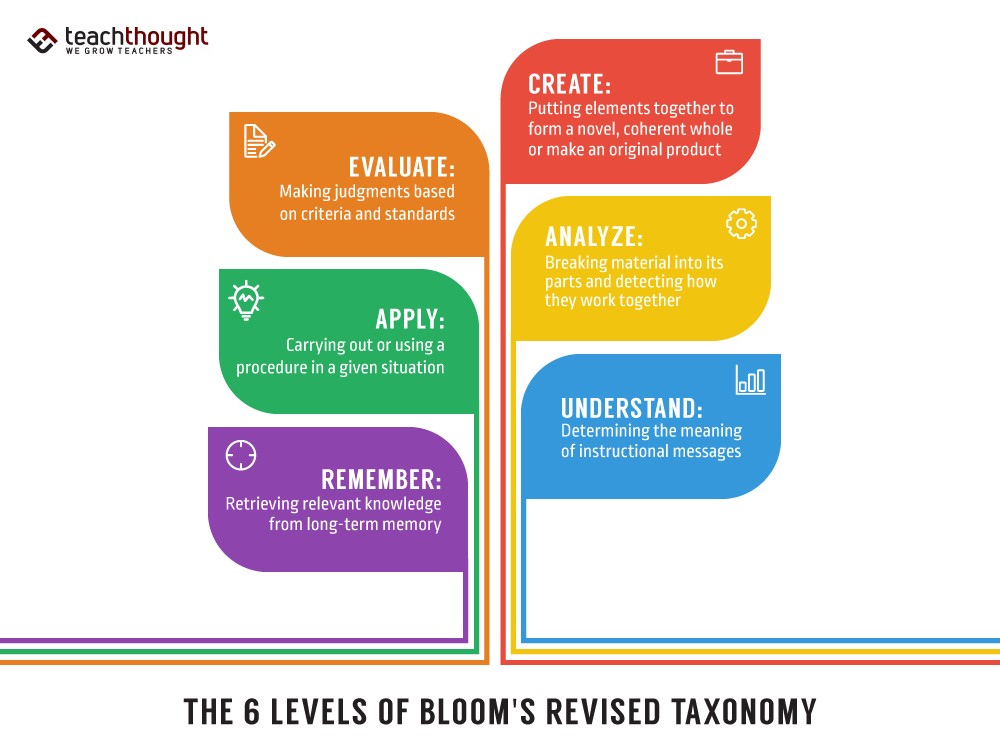
Bloom's Revised Taxonomy chart: Remember, Understand, Apply, Analyze, Evaluate, Create
Bloom’s Revised Taxonomy: cognitive process dimension

Bloom’s Revised Taxonomy changed the original 1956 framework by updating the level names to verbs, reordering the top levels, and adding a second dimension for types of knowledge. The revision clarifies what students do cognitively and how those actions interact with factual, conceptual, procedural, and metacognitive knowledge.

How Bloom’s Taxonomy Changed

  • Nouns to verbs: levels reframed as cognitive actions: Remember, Understand, Apply, Analyze, Evaluate, Create.
  • Top-level reorder: Create placed above Evaluate to reflect generative thinking.
  • Two dimensions: pair the Cognitive Process with the Knowledge Dimension (Factual, Conceptual, Procedural, Metacognitive).
  • Clearer alignment: objectives, instruction, and assessment mapped with the Taxonomy Table.
  • Modernized language: Comprehension becomes Understand; Knowledge becomes Remember.
  • Planning impact: encourages task verbs and evidence of learning rather than category labels.

Original vs Revised Level Names

Original (1956) Revised (2001)
KnowledgeRemember
ComprehensionUnderstand
ApplicationApply
AnalysisAnalyze
SynthesisCreate
EvaluationEvaluate

What Changed Beyond the Words

The revision introduced the Taxonomy Table: a grid that crosses six cognitive processes with four knowledge types. This helps teachers specify outcomes and assessments more precisely, for example, Analyze x using conceptual knowledge or Apply y using procedural knowledge.

  • Knowledge Dimension: Factual, Conceptual, Procedural, Metacognitive.
  • Process–knowledge pairing: clarifies task design and evidence quality.
  • Assessment implications: verb choice signals expected thinking and scoring focus.

Why It Was Revised

From 1995 to 2000, a team led by Lorin Anderson and David Krathwohl updated Bloom’s…


Sumber:
Baca selengkapnya

Ringkas artikel ini ke dalam bahasa Indonesia yang jelas dan formal maksimal 120-150 kata: Bloom’s Revised Taxonomy: cognitive process dimension…

Read More

Tulis ulang artikel berikut ke dalam bahasa Indonesia yang rapi, mudah dipahami, gaya formal pendidikan, minimal 300 kata:

Classroom Management Strategies

Classroom management strategies are the deliberate actions teachers use to organize learning conditions so students can participate productively. Effective management depends on how teachers build relationships, establish routines, design tasks, and respond to behavior in real time.

1. Relationship Building as a Classroom Management Strategy

Relationship building functions as a classroom management strategy because students are more likely to follow direction and remain engaged when they perceive the classroom as fair and predictable. Research has linked teacher-student relationships to improved behavioral and academic outcomes (Hamre & Pianta, 2001).

Strategies that develop this approach

Use targeted acknowledgment
Replace general praise with brief, specific feedback tied to effort or decision-making.

Build short, consistent interactions
Use transitions or independent work time for brief check-ins with individual students.

Structure participation to reduce social risk
Use partner or small-group structures before whole-class discussion.

2. Establishing Routines as a Classroom Management Strategy

Establishing routines reduces ambiguity and prevents repeated correction. Effective classrooms rely on explicitly taught procedures rather than assumed habits (Evertson & Emmer, 1982).

Strategies that develop this approach

Teach entry and start-of-task behavior
Begin each class with a consistent opening task.

Use visible cues for transitions
Post brief step sequences for common routines.

Re-teach routines when breakdown occurs
Pause and model again instead of repeating directions.

3. Task Design as a Classroom Management Strategy

Task design influences behavior. When work is unclear or mismatched in difficulty, students disengage or…


Sumber:
Baca selengkapnya

Ringkas artikel ini ke dalam bahasa Indonesia yang jelas dan formal maksimal 120-150 kata: Classroom Management Strategies Classroom management strategies…

Read More
Tulis ulang artikel berikut ke dalam bahasa Indonesia yang rapi, mudah dipahami, gaya formal pendidikan, minimal 300 kata: 


contributed by Dr. Athena Stanley


Artificial intelligence is increasingly present in education conversations. Some teachers are experimenting with it. Others are cautious. Many are simply unsure where it belongs or whether it belongs at all.


A recent Gallup poll found that three in ten teachers use AI weekly, with findings indicating improvements in the quality of certain tasks. The study also estimated that AI-supported work could amount to the equivalent of approximately six weeks of time saved over the course of a year. 


Meanwhile, a RAND study found that more than half of students and teachers report already using AI in school contexts, even as formal guidance and policy have struggled to keep pace. 


Amid concerns about plagiarism, bias, and the potential impact on students’ critical thinking skills, uncertainty is understandable. The question, then, may not be whether AI exists in education, but where it meaningfully fits within curriculum and assessment.


In some classrooms or contexts, integration may be limited in scope and highly intentional, emphasizing critical examination rather than routine or active use.


Several instructional domains offer starting points for this reflection. Rather than positioning AI as a solution or a threat, educators might consider how, and whether, it aligns with their instructional goals, assessment practices, and professional values.


1. Curriculum Planning and Lesson Design


Curriculum planning is one area where AI may intersect with teacher workflow, particularly during early stages of lesson design or brainstorming. Teachers may feel overwhelmed by the task, have too many ideas competing for attention, or be looking for ways to refresh familiar approaches. AI may help ease this “blank page” pressure by offering general overviews or serving as a brainstorming partner.


AI may also support more specific elements of lesson and unit planning, such as identifying alignment between...   Sumber: Baca selengkapnya

Tulis ulang artikel berikut ke dalam bahasa Indonesia yang rapi, mudah dipahami, gaya formal pendidikan, minimal 300 kata:

contributed by Dr. Athena Stanley

Artificial intelligence is increasingly present in education conversations. Some teachers are experimenting with it. Others are cautious. Many are simply unsure where it belongs or whether it belongs at all.

A recent Gallup poll found that three in ten teachers use AI weekly, with findings indicating improvements in the quality of certain tasks. The study also estimated that AI-supported work could amount to the equivalent of approximately six weeks of time saved over the course of a year.

Meanwhile, a RAND study found that more than half of students and teachers report already using AI in school contexts, even as formal guidance and policy have struggled to keep pace. 

Amid concerns about plagiarism, bias, and the potential impact on students’ critical thinking skills, uncertainty is understandable. The question, then, may not be whether AI exists in education, but where it meaningfully fits within curriculum and assessment.

In some classrooms or contexts, integration may be limited in scope and highly intentional, emphasizing critical examination rather than routine or active use.

Several instructional domains offer starting points for this reflection. Rather than positioning AI as a solution or a threat, educators might consider how, and whether, it aligns with their instructional goals, assessment practices, and professional values.

1. Curriculum Planning and Lesson Design

Curriculum planning is one area where AI may intersect with teacher workflow, particularly during early stages of lesson design or brainstorming. Teachers may feel overwhelmed by the task, have too many ideas competing for attention, or be looking for ways to refresh familiar approaches. AI may help ease this “blank page” pressure by offering general overviews or serving as a brainstorming partner.

AI may also support more specific elements of lesson and unit planning, such as identifying alignment between…


Sumber: Baca selengkapnya

Ringkas artikel ini ke dalam bahasa Indonesia yang jelas dan formal maksimal 120-150 kata: contributed by Dr. Athena Stanley Artificial…

Read More