Advertisement
Tulis ulang artikel berikut ke dalam bahasa Indonesia yang rapi, mudah dipahami, gaya formal pendidikan, minimal 300 kata: 


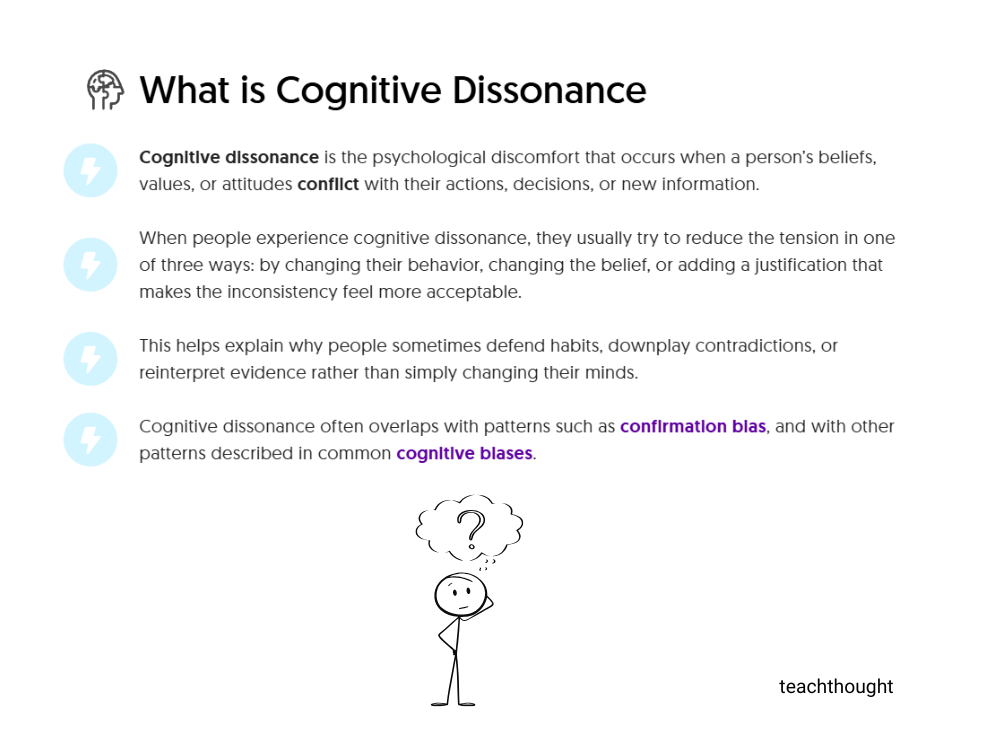
    Cognitive dissonance is the psychological discomfort people feel when their beliefs, values, or self-image conflict with their actions, decisions, or new information.


    Definition
    Cognitive dissonance is a theory in psychology describing the tension that arises when a person holds inconsistent beliefs, or when behavior conflicts with stated values. That discomfort often motivates the person to reduce the inconsistency by changing behavior, revising beliefs, or adding a justification.


    Key Characteristics of Cognitive Dissonance
    
      It involves felt psychological discomfort, not just a contradiction on paper.
      It usually appears when an action, belief, value, or identity claim does not align with another important cognition.
      The discomfort tends to be stronger when the issue matters to the person or affects how they see themselves.
      People are often motivated to reduce the tension quickly, but not always rationally.
      Resolution may involve honest change, but it may also involve defensiveness, distortion, or rationalization.


  How Cognitive Dissonance Typically Unfolds

  
    1. A conflict appears
    A belief, value, or self-image clashes with a behavior, decision, or new information.
    Example: A student believes honesty matters but cheats on an assignment.


    2. Discomfort is felt
    The inconsistency creates internal tension such as unease, guilt, defensiveness, or pressure to explain the mismatch.
    Example: The student sees the behavior as inconsistent with being an honest person.


    3. A response follows
    The person tries to reduce the discomfort by changing the behavior, changing the belief, or adding a justification.
    Example: The student stops cheating, redefines the act as “not really cheating,” or claims the assignment was unfair.


    Three Common Ways People Reduce Cognitive Dissonance

    
      1. Change behavior
      The person...   Sumber: Baca selengkapnya

Tulis ulang artikel berikut ke dalam bahasa Indonesia yang rapi, mudah dipahami, gaya formal pendidikan, minimal 300 kata:

Cognitive dissonance is the psychological discomfort people feel when their beliefs, values, or self-image conflict with their actions, decisions, or new information.

Definition

Cognitive dissonance is a theory in psychology describing the tension that arises when a person holds inconsistent beliefs, or when behavior conflicts with stated values. That discomfort often motivates the person to reduce the inconsistency by changing behavior, revising beliefs, or adding a justification.

Key Characteristics of Cognitive Dissonance

  • It involves felt psychological discomfort, not just a contradiction on paper.
  • It usually appears when an action, belief, value, or identity claim does not align with another important cognition.
  • The discomfort tends to be stronger when the issue matters to the person or affects how they see themselves.
  • People are often motivated to reduce the tension quickly, but not always rationally.
  • Resolution may involve honest change, but it may also involve defensiveness, distortion, or rationalization.

How Cognitive Dissonance Typically Unfolds

1. A conflict appears

A belief, value, or self-image clashes with a behavior, decision, or new information.

Example: A student believes honesty matters but cheats on an assignment.

2. Discomfort is felt

The inconsistency creates internal tension such as unease, guilt, defensiveness, or pressure to explain the mismatch.

Example: The student sees the behavior as inconsistent with being an honest person.

3. A response follows

The person tries to reduce the discomfort by changing the behavior, changing the belief, or adding a justification.

Example: The student stops cheating, redefines the act as “not really cheating,” or claims the assignment was unfair.

Three Common Ways People Reduce Cognitive Dissonance

1. Change behavior

The person…


Sumber:
Baca selengkapnya

Ringkas artikel ini ke dalam bahasa Indonesia yang jelas dan formal maksimal 120-150 kata: Cognitive dissonance is the psychological discomfort…

Read More
Tulis ulang artikel berikut ke dalam bahasa Indonesia yang rapi, mudah dipahami, gaya formal pendidikan, minimal 300 kata: 


contributed by Dr. Athena Stanley


Artificial intelligence is increasingly present in education conversations. Some teachers are experimenting with it. Others are cautious. Many are simply unsure where it belongs or whether it belongs at all.


A recent Gallup poll found that three in ten teachers use AI weekly, with findings indicating improvements in the quality of certain tasks. The study also estimated that AI-supported work could amount to the equivalent of approximately six weeks of time saved over the course of a year. 


Meanwhile, a RAND study found that more than half of students and teachers report already using AI in school contexts, even as formal guidance and policy have struggled to keep pace. 


Amid concerns about plagiarism, bias, and the potential impact on students’ critical thinking skills, uncertainty is understandable. The question, then, may not be whether AI exists in education, but where it meaningfully fits within curriculum and assessment.


In some classrooms or contexts, integration may be limited in scope and highly intentional, emphasizing critical examination rather than routine or active use.


Several instructional domains offer starting points for this reflection. Rather than positioning AI as a solution or a threat, educators might consider how, and whether, it aligns with their instructional goals, assessment practices, and professional values.


1. Curriculum Planning and Lesson Design


Curriculum planning is one area where AI may intersect with teacher workflow, particularly during early stages of lesson design or brainstorming. Teachers may feel overwhelmed by the task, have too many ideas competing for attention, or be looking for ways to refresh familiar approaches. AI may help ease this “blank page” pressure by offering general overviews or serving as a brainstorming partner.


AI may also support more specific elements of lesson and unit planning, such as identifying alignment between...   Sumber: Baca selengkapnya

Tulis ulang artikel berikut ke dalam bahasa Indonesia yang rapi, mudah dipahami, gaya formal pendidikan, minimal 300 kata:

contributed by Dr. Athena Stanley

Artificial intelligence is increasingly present in education conversations. Some teachers are experimenting with it. Others are cautious. Many are simply unsure where it belongs or whether it belongs at all.

A recent Gallup poll found that three in ten teachers use AI weekly, with findings indicating improvements in the quality of certain tasks. The study also estimated that AI-supported work could amount to the equivalent of approximately six weeks of time saved over the course of a year.

Meanwhile, a RAND study found that more than half of students and teachers report already using AI in school contexts, even as formal guidance and policy have struggled to keep pace. 

Amid concerns about plagiarism, bias, and the potential impact on students’ critical thinking skills, uncertainty is understandable. The question, then, may not be whether AI exists in education, but where it meaningfully fits within curriculum and assessment.

In some classrooms or contexts, integration may be limited in scope and highly intentional, emphasizing critical examination rather than routine or active use.

Several instructional domains offer starting points for this reflection. Rather than positioning AI as a solution or a threat, educators might consider how, and whether, it aligns with their instructional goals, assessment practices, and professional values.

1. Curriculum Planning and Lesson Design

Curriculum planning is one area where AI may intersect with teacher workflow, particularly during early stages of lesson design or brainstorming. Teachers may feel overwhelmed by the task, have too many ideas competing for attention, or be looking for ways to refresh familiar approaches. AI may help ease this “blank page” pressure by offering general overviews or serving as a brainstorming partner.

AI may also support more specific elements of lesson and unit planning, such as identifying alignment between…


Sumber: Baca selengkapnya

Ringkas artikel ini ke dalam bahasa Indonesia yang jelas dan formal maksimal 120-150 kata: contributed by Dr. Athena Stanley Artificial…

Read More