Advertisement
Tulis ulang artikel berikut ke dalam bahasa Indonesia yang rapi, mudah dipahami, gaya formal pendidikan, minimal 300 kata: 
	
contributed by Tulika Samal


In today’s rapidly changing world, the ability to think critically is more valuable than ever.

Mathematics, often perceived as a subject of numbers and formulas, is in fact one of the most powerful tools for developing critical thinking. At the heart of meaningful mathematics lies the ability to analyze, interpret, and justify reasoning.

Why Mathematical Reasoning Matters More Than Memorization

For many learners, mathematics becomes a set of procedures to memorize; apply a formula, follow steps, and arrive at an answer. While this approach may produce correct results in familiar situations, it often falls short when students encounter new or complex problems. True mathematical reasoning begins when students ask:


  Why does this work?
  What does this result mean?
  Can this be solved in another way?


Developing reasoning shifts the focus from simply getting the answer to understanding the process. For example, instead of just calculating a discount, a student explains why 20% off followed by 10% is not the same as 30% off.

Mathematical reasoning helps in real life decision-making such as budgeting, comparing offers, and interpreting data. It helps to build problem solving confidence and independence. Mathematical reasoning also supports careers in fields like STEM and finance.

What Mathematical Reasoning Involves

Mathematical reasoning is not just getting an answer. It involves analyzing a problem, interpreting what the result means, and justifying why the thinking is sound.


      What Mathematical Reasoning Involves
      
        Mathematical reasoning is not just getting an answer. It involves analyzing a problem, interpreting what the result means, and justifying why the thinking is sound.


            Reasoning Skill
            What Students Do
            Example
            Why It Matters


          ...   Sumber: Baca selengkapnya

Tulis ulang artikel berikut ke dalam bahasa Indonesia yang rapi, mudah dipahami, gaya formal pendidikan, minimal 300 kata:

contributed by Tulika Samal

In today’s rapidly changing world, the ability to think critically is more valuable than ever.

Mathematics, often perceived as a subject of numbers and formulas, is in fact one of the most powerful tools for developing critical thinking. At the heart of meaningful mathematics lies the ability to analyze, interpret, and justify reasoning.

Why Mathematical Reasoning Matters More Than Memorization

For many learners, mathematics becomes a set of procedures to memorize; apply a formula, follow steps, and arrive at an answer. While this approach may produce correct results in familiar situations, it often falls short when students encounter new or complex problems. True mathematical reasoning begins when students ask:

  • Why does this work?
  • What does this result mean?
  • Can this be solved in another way?

Developing reasoning shifts the focus from simply getting the answer to understanding the process. For example, instead of just calculating a discount, a student explains why 20% off followed by 10% is not the same as 30% off.

Mathematical reasoning helps in real life decision-making such as budgeting, comparing offers, and interpreting data. It helps to build problem solving confidence and independence. Mathematical reasoning also supports careers in fields like STEM and finance.

What Mathematical Reasoning Involves

Mathematical reasoning is not just getting an answer. It involves analyzing a problem, interpreting what the result means, and justifying why the thinking is sound.

What Mathematical Reasoning Involves

Mathematical reasoning is not just getting an answer. It involves analyzing a problem, interpreting what the result means, and justifying why the thinking is sound.

Reasoning Skill What Students Do Example Why It Matters


Sumber:
Baca selengkapnya

Ringkas artikel ini ke dalam bahasa Indonesia yang jelas dan formal maksimal 120-150 kata: contributed by Tulika Samal In today’s…

Read More

Tulis ulang artikel berikut ke dalam bahasa Indonesia yang rapi, mudah dipahami, gaya formal pendidikan, minimal 300 kata: 


by Terry Heick


There are ideas and then there are ideas between ideas.


The spaces between ideas can be pregnant with ideas of their own in the same way that there are stars and then there are spaces between the stars. And these spaces matter because they’re dark and dark (and its absence) characterizes light.


Okay, how about this: Every reality has factors. Every effect has a cause. Every data point has a context. You can separate these relationships in a temporary kind of singularity in order to examine them, but in doing so risk losing the thing itself because the thing doesn’t just have a context but only exists in a context.


We may fail to recognize these factors and causes and contexts, but they’re there. We may fail to extract the right lessons from these factors and realities and causes and effects and contexts and data, but they’re there, ready to be extracted.


And it’s not just about contexts and relationships. There are distinctions here too—nuanced distinctions that are not minor. The difference, for example, between causation and correlation. The difference between cause and effect but also the reality that it’s all relative (context) and recursive and non-linear. One thing ends and another begins and one causes the other and defines the other and depends on the other but are also entirely separate.


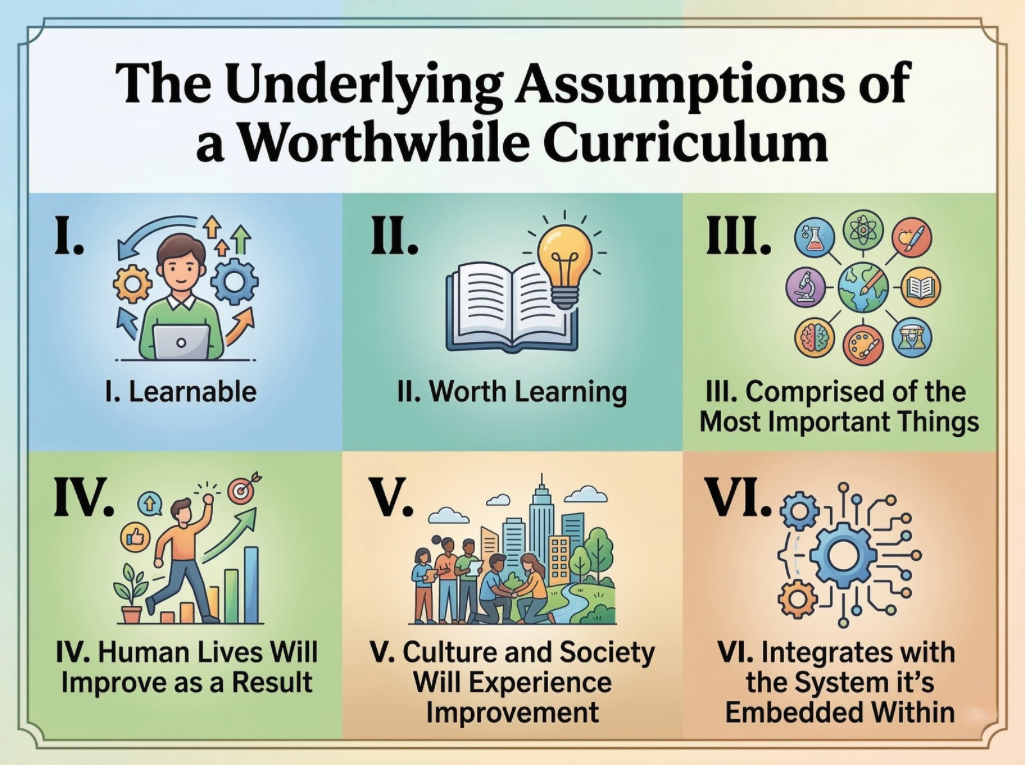
Which brings us to underlying assumptions.


That there are underlying assumptions that we ‘bring’ to a thought or decision may be more interesting than examining one set of underlying assumptions themselves, but we’re here for innovation in education, not epistemology.


Note: These aren’t in any sort of order because sometimes one needs another for context so I couldn’t, for example, leave #2 for last (as the most important) because it helped flesh out the rest and I thought #1 should be first even though it may not be the most important.


The Assumptions And Characteristics Of A Curriculum


I....   Sumber: Baca selengkapnya

Tulis ulang artikel berikut ke dalam bahasa Indonesia yang rapi, mudah dipahami, gaya formal pendidikan, minimal 300 kata:

by Terry Heick

There are ideas and then there are ideas between ideas.

The spaces between ideas can be pregnant with ideas of their own in the same way that there are stars and then there are spaces between the stars. And these spaces matter because they’re dark and dark (and its absence) characterizes light.

Okay, how about this: Every reality has factors. Every effect has a cause. Every data point has a context. You can separate these relationships in a temporary kind of singularity in order to examine them, but in doing so risk losing the thing itself because the thing doesn’t just have a context but only exists in a context.

We may fail to recognize these factors and causes and contexts, but they’re there. We may fail to extract the right lessons from these factors and realities and causes and effects and contexts and data, but they’re there, ready to be extracted.

And it’s not just about contexts and relationships. There are distinctions here too—nuanced distinctions that are not minor. The difference, for example, between causation and correlation. The difference between cause and effect but also the reality that it’s all relative (context) and recursive and non-linear. One thing ends and another begins and one causes the other and defines the other and depends on the other but are also entirely separate.

Which brings us to underlying assumptions.

That there are underlying assumptions that we ‘bring’ to a thought or decision may be more interesting than examining one set of underlying assumptions themselves, but we’re here for innovation in education, not epistemology.

Note: These aren’t in any sort of order because sometimes one needs another for context so I couldn’t, for example, leave #2 for last (as the most important) because it helped flesh out the rest and I thought #1 should be first even though it may not be the most important.

The Assumptions And Characteristics Of A Curriculum

I….


Sumber:
Baca selengkapnya

Ringkas artikel ini ke dalam bahasa Indonesia yang jelas dan formal maksimal 120-150 kata: by Terry Heick There are ideas…

Read More
Tulis ulang artikel berikut ke dalam bahasa Indonesia yang rapi, mudah dipahami, gaya formal pendidikan, minimal 300 kata: 
	
Teaching Students to Navigate Common Digital File Challenges


In today’s learning area, working with digital files is an integral part of the educational process. Students create, save, share, and edit various documents every day. 


They can range from simple text files to complex multimedia projects. Meanwhile, with technological progress, many students face challenges that hinder effective learning. That’s why the skill to navigate the digital space is no longer just an extra one.  It must now be a core competency. 


Teaching students to overcome these challenges means not only improving their academic performance. It is also about preparing them for the real world. A place where digital literacy is critically important.


See also 15 Ways To Share Digital Files


Digital File Challenges in Education. 


The first step toward solving the problem is to recognize its scope. Digital file challenges arise due to:


A lack of systematic organization;


Insufficient understanding of file formats;


Incorrect approaches to data storage.


Students often get lost among a large number of documents or cannot find the files they need. They also frequently submit work in the wrong format. In such a context, there is a need to teach not only technical skills. Here appears the need for the logic behind working with files. If a student understands why certain formats are suitable for specific tasks, they can avoid many problems. 


Here it’s a good idea to look into tools that simplify working with file formats. A practical example is when students use images in HEIC format. These may not open on many devices or platforms. In such cases, tools acting as HEIC to PNG converter come in handy. This can allow you to quickly change the file format without losing quality. They also ensure compatibility with most systems. In this way, you can avoid technical issues when submitting assignments. Also, you’ll make the learning process smoother.


Student...   Sumber: Baca selengkapnya

Tulis ulang artikel berikut ke dalam bahasa Indonesia yang rapi, mudah dipahami, gaya formal pendidikan, minimal 300 kata:

Teaching Students to Navigate Common Digital File Challenges

In today’s learning area, working with digital files is an integral part of the educational process. Students create, save, share, and edit various documents every day.

They can range from simple text files to complex multimedia projects. Meanwhile, with technological progress, many students face challenges that hinder effective learning. That’s why the skill to navigate the digital space is no longer just an extra one.  It must now be a core competency.

Teaching students to overcome these challenges means not only improving their academic performance. It is also about preparing them for the real world. A place where digital literacy is critically important.

See also 15 Ways To Share Digital Files

Digital File Challenges in Education. 

The first step toward solving the problem is to recognize its scope. Digital file challenges arise due to:

  • A lack of systematic organization;
  • Insufficient understanding of file formats;
  • Incorrect approaches to data storage.

Students often get lost among a large number of documents or cannot find the files they need. They also frequently submit work in the wrong format. In such a context, there is a need to teach not only technical skills. Here appears the need for the logic behind working with files. If a student understands why certain formats are suitable for specific tasks, they can avoid many problems.

Here it’s a good idea to look into tools that simplify working with file formats. A practical example is when students use images in HEIC format. These may not open on many devices or platforms. In such cases, tools acting as HEIC to PNG converter come in handy. This can allow you to quickly change the file format without losing quality. They also ensure compatibility with most systems. In this way, you can avoid technical issues when submitting assignments. Also, you’ll make the learning process smoother.

Student…


Sumber: Baca selengkapnya

Ringkas artikel ini ke dalam bahasa Indonesia yang jelas dan formal maksimal 120-150 kata: Teaching Students to Navigate Common Digital…

Read More