Advertisement
Tulis ulang artikel berikut ke dalam bahasa Indonesia yang rapi, mudah dipahami, gaya formal pendidikan, minimal 300 kata: 
	
When Accommodations Exist but Access Doesn’t: A Middle School Reality Check 


contributed by Pramod Polimari, middle school special education strategist


In middle school classrooms across the country, accommodations are in place. 


IEPs are written. 


Support plans are documented. 


Students are technically “included.” 


And yet, many students still struggle to access learning in meaningful ways. 


This disconnect—where accommodations exist on paper but access breaks down in practice—is one of the most common and least discussed challenges in middle school education. It’s rarely the result of negligence or lack of care. More often, it emerges from well-intentioned assumptions about independence, readiness, and what middle school students “should” be able to manage on their own. 


The Middle School Shift That Changes Everything 


Middle school marks a sharp transition. Expectations increase rapidly, not just academically but behaviorally and cognitively. Students are expected to manage multiple teachers, track assignments independently, navigate complex schedules, and keep pace with faster instruction. 


For students with learning disabilities, ADHD, or executive functioning challenges, this shift can quietly dismantle access—even when accommodations are technically available. 


The challenge isn’t that accommodations disappear. It’s that the environment changes around them. 


What worked in elementary school often assumes a level of adult scaffolding that middle school systems quietly remove. The result is a growing gap between what students are entitled to receive and what they can realistically use during instruction. 


When Independence Becomes an Assumption, Not a Skill 


One of the most common middle school assumptions is that students should now “self-advocate” and “manage their accommodations.” 


In theory, this sounds reasonable. Independence is an important long-term goal....   Sumber: Baca selengkapnya

Tulis ulang artikel berikut ke dalam bahasa Indonesia yang rapi, mudah dipahami, gaya formal pendidikan, minimal 300 kata:

When Accommodations Exist but Access Doesn’t: A Middle School Reality Check 

contributed by Pramod Polimari, middle school special education strategist

In middle school classrooms across the country, accommodations are in place. 

IEPs are written. 

Support plans are documented. 

Students are technically “included.” 

And yet, many students still struggle to access learning in meaningful ways. 

This disconnect—where accommodations exist on paper but access breaks down in practice—is one of the most common and least discussed challenges in middle school education. It’s rarely the result of negligence or lack of care. More often, it emerges from well-intentioned assumptions about independence, readiness, and what middle school students “should” be able to manage on their own. 

The Middle School Shift That Changes Everything 

Middle school marks a sharp transition. Expectations increase rapidly, not just academically but behaviorally and cognitively. Students are expected to manage multiple teachers, track assignments independently, navigate complex schedules, and keep pace with faster instruction. 

For students with learning disabilities, ADHD, or executive functioning challenges, this shift can quietly dismantle access—even when accommodations are technically available. 

The challenge isn’t that accommodations disappear. It’s that the environment changes around them. 

What worked in elementary school often assumes a level of adult scaffolding that middle school systems quietly remove. The result is a growing gap between what students are entitled to receive and what they can realistically use during instruction. 

When Independence Becomes an Assumption, Not a Skill 

One of the most common middle school assumptions is that students should now “self-advocate” and “manage their accommodations.” 

In theory, this sounds reasonable. Independence is an important long-term goal….


Sumber:
Baca selengkapnya

Ringkas artikel ini ke dalam bahasa Indonesia yang jelas dan formal maksimal 120-150 kata: When Accommodations Exist but Access Doesn’t:…

Read More
Tulis ulang artikel berikut ke dalam bahasa Indonesia yang rapi, mudah dipahami, gaya formal pendidikan, minimal 300 kata: 


by Terry Heick


There are ideas and then there are ideas between ideas.


The spaces between ideas can be pregnant with ideas of their own in the same way that there are stars and then there are spaces between the stars. And these spaces matter because they’re dark and dark (and its absence) characterizes light.


Okay, how about this: Every reality has factors. Every effect has a cause. Every data point has a context. You can separate these relationships in a temporary kind of singularity in order to examine them, but in doing so risk losing the thing itself because the thing doesn’t just have a context but only exists in a context.


We may fail to recognize these factors and causes and contexts, but they’re there. We may fail to extract the right lessons from these factors and realities and causes and effects and contexts and data, but they’re there, ready to be extracted.


And it’s not just about contexts and relationships. There are distinctions here too—nuanced distinctions that are not minor. The difference, for example, between causation and correlation. The difference between cause and effect but also the reality that it’s all relative (context) and recursive and non-linear. One thing ends and another begins and one causes the other and defines the other and depends on the other but are also entirely separate.


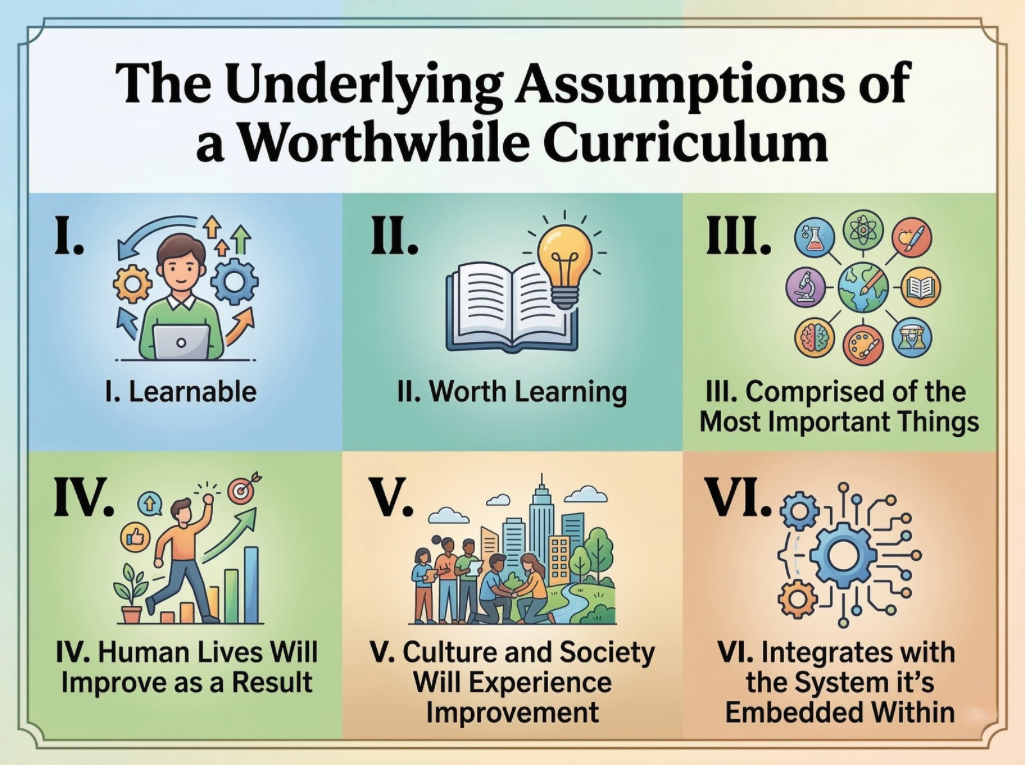
Which brings us to underlying assumptions.


That there are underlying assumptions that we ‘bring’ to a thought or decision may be more interesting than examining one set of underlying assumptions themselves, but we’re here for innovation in education, not epistemology.


Note: These aren’t in any sort of order because sometimes one needs another for context so I couldn’t, for example, leave #2 for last (as the most important) because it helped flesh out the rest and I thought #1 should be first even though it may not be the most important.


The Assumptions And Characteristics Of A Curriculum


I....   Sumber: Baca selengkapnya

Tulis ulang artikel berikut ke dalam bahasa Indonesia yang rapi, mudah dipahami, gaya formal pendidikan, minimal 300 kata:

by Terry Heick

There are ideas and then there are ideas between ideas.

The spaces between ideas can be pregnant with ideas of their own in the same way that there are stars and then there are spaces between the stars. And these spaces matter because they’re dark and dark (and its absence) characterizes light.

Okay, how about this: Every reality has factors. Every effect has a cause. Every data point has a context. You can separate these relationships in a temporary kind of singularity in order to examine them, but in doing so risk losing the thing itself because the thing doesn’t just have a context but only exists in a context.

We may fail to recognize these factors and causes and contexts, but they’re there. We may fail to extract the right lessons from these factors and realities and causes and effects and contexts and data, but they’re there, ready to be extracted.

And it’s not just about contexts and relationships. There are distinctions here too—nuanced distinctions that are not minor. The difference, for example, between causation and correlation. The difference between cause and effect but also the reality that it’s all relative (context) and recursive and non-linear. One thing ends and another begins and one causes the other and defines the other and depends on the other but are also entirely separate.

Which brings us to underlying assumptions.

That there are underlying assumptions that we ‘bring’ to a thought or decision may be more interesting than examining one set of underlying assumptions themselves, but we’re here for innovation in education, not epistemology.

Note: These aren’t in any sort of order because sometimes one needs another for context so I couldn’t, for example, leave #2 for last (as the most important) because it helped flesh out the rest and I thought #1 should be first even though it may not be the most important.

The Assumptions And Characteristics Of A Curriculum

I….


Sumber:
Baca selengkapnya

Ringkas artikel ini ke dalam bahasa Indonesia yang jelas dan formal maksimal 120-150 kata: by Terry Heick There are ideas…

Read More