Advertisement
Tulis ulang artikel berikut ke dalam bahasa Indonesia yang rapi, mudah dipahami, gaya formal pendidikan, minimal 300 kata: 


contributed by Meg Price, the ei experience


Social-emotional learning (SEL) by definition is a process for learning life skills, including how to deal with oneself, others, and relationships, and work in an effective manner.


Although there are many great SEL programs, SEL can also be incorporated into each lesson as a way of teaching students to understand how to action the skills in a variety of situations and form positive habits. All students start school with some level of social and emotional skills, and all will develop their social and emotional skills at different rates.


Parents and teachers are both responsible for teaching students life skills, and certainly, much of what they learn will be by watching our actions. The five strategies below are will not only benefit students’ social-emotional learning, but can also be beneficial to teachers’ well-being, too.


See also The Benefits Of Social-Emotional Learning


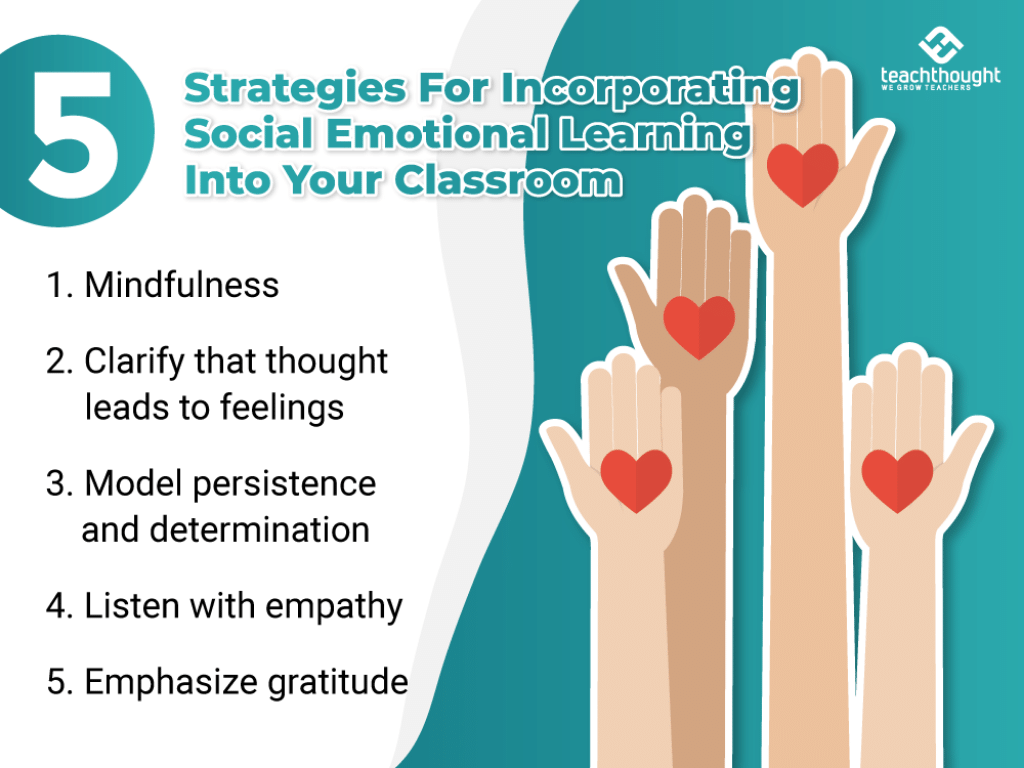
5 Strategies For Incorporating Social-Emotional Learning Into Your Classroom 


1. Through mindfulness


Mindfulness is: paying attention, in a particular way, on purpose, in the present moment, non-judgmentally.


We are hearing more and more about the benefits of mindfulness for children. Increased attention leads to better performance academically and increased emotional and social intelligence. Children are better able to learn, nurture themselves, and be aware of their own emotional needs.


Mindfulness practices help students focus on their breath, body, thoughts, feelings, and the world around them. When they can observe their thoughts and feelings, they have the freedom to choose how they will speak and act–which can lead to a happier, more harmonious classroom.


There are many mindfulness activities available for free–on YouTube, for example. Further, there are mindfulness and meditation apps that can provide frameworks for getting started. Why not start each lesson with a different mindfulness...   Sumber: Baca selengkapnya

Tulis ulang artikel berikut ke dalam bahasa Indonesia yang rapi, mudah dipahami, gaya formal pendidikan, minimal 300 kata:

contributed by Meg Price, the ei experience

Social-emotional learning (SEL) by definition is a process for learning life skills, including how to deal with oneself, others, and relationships, and work in an effective manner.

Although there are many great SEL programs, SEL can also be incorporated into each lesson as a way of teaching students to understand how to action the skills in a variety of situations and form positive habits. All students start school with some level of social and emotional skills, and all will develop their social and emotional skills at different rates.

Parents and teachers are both responsible for teaching students life skills, and certainly, much of what they learn will be by watching our actions. The five strategies below are will not only benefit students’ social-emotional learning, but can also be beneficial to teachers’ well-being, too.

See also The Benefits Of Social-Emotional Learning

5 Strategies For Incorporating Social-Emotional Learning Into Your Classroom

1. Through mindfulness

Mindfulness is: paying attention, in a particular way, on purpose, in the present moment, non-judgmentally.

We are hearing more and more about the benefits of mindfulness for children. Increased attention leads to better performance academically and increased emotional and social intelligence. Children are better able to learn, nurture themselves, and be aware of their own emotional needs.

Mindfulness practices help students focus on their breath, body, thoughts, feelings, and the world around them. When they can observe their thoughts and feelings, they have the freedom to choose how they will speak and act–which can lead to a happier, more harmonious classroom.

There are many mindfulness activities available for free–on YouTube, for example. Further, there are mindfulness and meditation apps that can provide frameworks for getting started. Why not start each lesson with a different mindfulness…


Sumber: Baca selengkapnya

Ringkas artikel ini ke dalam bahasa Indonesia yang jelas dan formal maksimal 120-150 kata: contributed by Meg Price, the ei…

Read More
Tulis ulang artikel berikut ke dalam bahasa Indonesia yang rapi, mudah dipahami, gaya formal pendidikan, minimal 300 kata: 
            The following list highlights platforms verified by ESSA standards, university research, and widespread adoption by educators from grade 3 through higher education.


            An online math and reading-focused learning platform that provides 1:1 learning, personalized lessons, and parent reporting. Before creating a study plan, this K-12 resource runs a diagnostic check to identify gaps, then appoints a specialized tutor to move the student toward advanced topics while following US educational requirements.


            2. Zearn Math
            A top-rated digital curriculum built on Eureka Math. It holds ESSA Tier 1 status for its proven ability to close achievement gaps through a mix of digital lessons and small-group instruction.


            3. ST Math
            Created by the MIND Research Institute, this visual-first program uses spatial-temporal reasoning to teach math concepts without language barriers, making it ideal for ELL students and early learners.


            4. IXL Math
            The industry standard for skill fluency. It provides a “Real-Time Diagnostic” that gives educators a precise snapshot of student proficiency across all state standards.


            5. Desmos Classroom
            Beyond its famous graphing calculator, Desmos offers free, high-quality digital activities that encourage students to model math and share their reasoning with the class in real-time.


            6. Khan Academy
            A non-profit providing a massive library of standards-aligned videos and practice exercises. Its new AI tutor, Khanmigo, offers Socratic coaching to guide students through difficult proofs.


            7. WolframAlpha
            A computational engine essential for higher education (Grades 12-20). It provides step-by-step solutions for complex calculus, linear algebra,...   Sumber: Baca selengkapnya

Tulis ulang artikel berikut ke dalam bahasa Indonesia yang rapi, mudah dipahami, gaya formal pendidikan, minimal 300 kata:

The following list highlights platforms verified by ESSA standards, university research, and widespread adoption by educators from grade 3 through higher education.

An online math and reading-focused learning platform that provides 1:1 learning, personalized lessons, and parent reporting. Before creating a study plan, this K-12 resource runs a diagnostic check to identify gaps, then appoints a specialized tutor to move the student toward advanced topics while following US educational requirements.

2. Zearn Math

A top-rated digital curriculum built on Eureka Math. It holds ESSA Tier 1 status for its proven ability to close achievement gaps through a mix of digital lessons and small-group instruction.

3. ST Math

Created by the MIND Research Institute, this visual-first program uses spatial-temporal reasoning to teach math concepts without language barriers, making it ideal for ELL students and early learners.

4. IXL Math

The industry standard for skill fluency. It provides a “Real-Time Diagnostic” that gives educators a precise snapshot of student proficiency across all state standards.

5. Desmos Classroom

Beyond its famous graphing calculator, Desmos offers free, high-quality digital activities that encourage students to model math and share their reasoning with the class in real-time.

6. Khan Academy

A non-profit providing a massive library of standards-aligned videos and practice exercises. Its new AI tutor, Khanmigo, offers Socratic coaching to guide students through difficult proofs.

7. WolframAlpha

A computational engine essential for higher education (Grades 12-20). It provides step-by-step solutions for complex calculus, linear algebra,…


Sumber:
Baca selengkapnya

Ringkas artikel ini ke dalam bahasa Indonesia yang jelas dan formal maksimal 120-150 kata: The following list highlights platforms verified…

Read More
Tulis ulang artikel berikut ke dalam bahasa Indonesia yang rapi, mudah dipahami, gaya formal pendidikan, minimal 300 kata: 
	
contributed by Mike Brown, education researcher at preppool.


Every educator has seen it.


A thoughtful, engaged student studies diligently, participates in class discussions, completes assignments on time—and then underperforms on the first major assessment.


The disappointment is visible. Sometimes the teacher feels it just as strongly as the student.


The instinctive explanations are familiar: anxiety, distraction, poor time management, lack of effort. But if this pattern repeats across classrooms and grade levels, it may point to something more structural.


What if first-time underperformance is less about student shortcomings and more about how we design learning?


If we look closely, many learning environments unintentionally reward familiarity over retrieval, coverage over coherence, and comfort over cognitive strain. Students leave review sessions feeling confident—only to discover that confidence was built on recognition, not recall.


That distinction matters more than we often admit.


The Gap Between Knowing and Being Able to Retrieve


In most classrooms, preparation looks something like this:


Students reread notes.


They highlight key passages.


They review slides.


They skim summaries.


These activities feel productive. There is visible effort. There is time invested. There is even a sense of clarity while reviewing.


But recognition is not retrieval.


When information is in front of us, it feels accessible. When it isn’t, the experience changes. Exams and performance tasks require students to produce knowledge independently—sometimes under time constraints, sometimes in unfamiliar formats.


The problem is not that students don’t “know” the material. The problem is that they have not practiced retrieving it often enough.


In research work examining exam-readiness behaviors—including analysis conducted by the team at PrepPool studying assessment performance trends—one pattern appears...   Sumber: Baca selengkapnya

Tulis ulang artikel berikut ke dalam bahasa Indonesia yang rapi, mudah dipahami, gaya formal pendidikan, minimal 300 kata:

contributed by Mike Brown, education researcher at preppool.

Every educator has seen it.

A thoughtful, engaged student studies diligently, participates in class discussions, completes assignments on time—and then underperforms on the first major assessment.

The disappointment is visible. Sometimes the teacher feels it just as strongly as the student.

The instinctive explanations are familiar: anxiety, distraction, poor time management, lack of effort. But if this pattern repeats across classrooms and grade levels, it may point to something more structural.

What if first-time underperformance is less about student shortcomings and more about how we design learning?

If we look closely, many learning environments unintentionally reward familiarity over retrieval, coverage over coherence, and comfort over cognitive strain. Students leave review sessions feeling confident—only to discover that confidence was built on recognition, not recall.

That distinction matters more than we often admit.

The Gap Between Knowing and Being Able to Retrieve

In most classrooms, preparation looks something like this:

Students reread notes.

They highlight key passages.

They review slides.

They skim summaries.

These activities feel productive. There is visible effort. There is time invested. There is even a sense of clarity while reviewing.

But recognition is not retrieval.

When information is in front of us, it feels accessible. When it isn’t, the experience changes. Exams and performance tasks require students to produce knowledge independently—sometimes under time constraints, sometimes in unfamiliar formats.

The problem is not that students don’t “know” the material. The problem is that they have not practiced retrieving it often enough.

In research work examining exam-readiness behaviors—including analysis conducted by the team at PrepPool studying assessment performance trends—one pattern appears…


Sumber: Baca selengkapnya

Ringkas artikel ini ke dalam bahasa Indonesia yang jelas dan formal maksimal 120-150 kata: contributed by Mike Brown, education researcher…

Read More