Ringkas artikel ini ke dalam bahasa Indonesia yang jelas dan formal maksimal 120-150 kata:
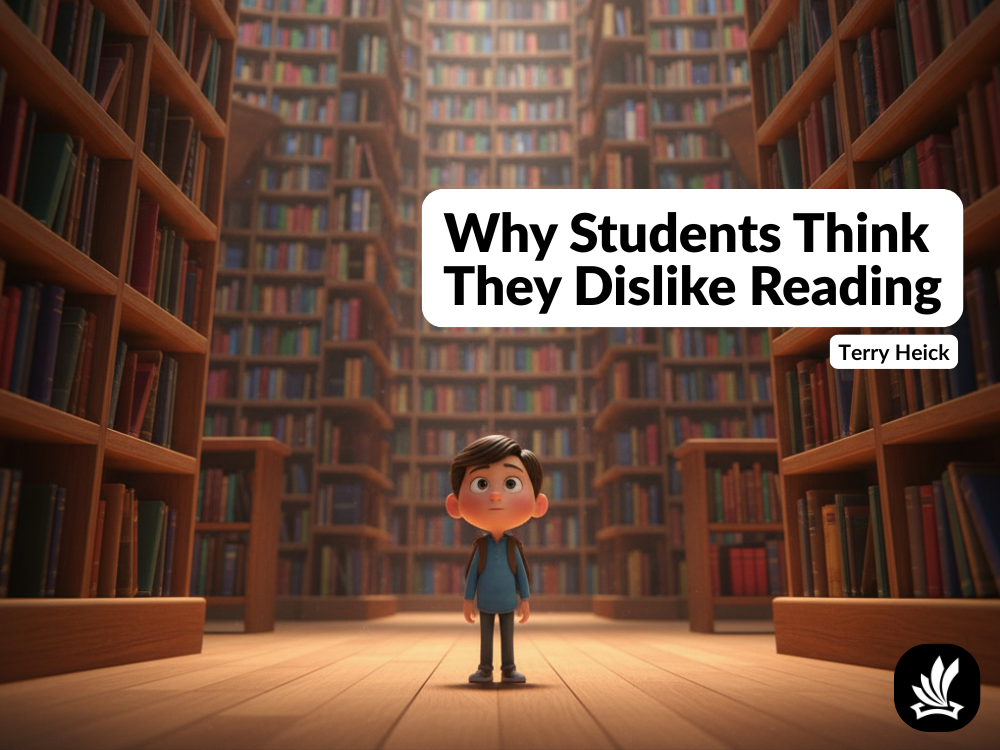
contributed by Alan Davson
‘Anyone who has visited my classroom knows how much I love words.
I teach multimedia arts, but I talk about words so much that most people assume I must be an English teacher.
Over the years, no matter what subject I taught, I kept noticing the same pattern. My students
were bright, creative, and capable, but they were often easily thrown when they encountered
unfamiliar words.
Sometimes it only took one word to derail them. Some students could sound things out, but when asked to explain what the word meant, they would shut down.
Some students could sound things out, but when asked to explain what the word meant, they would shut down.
At a certain point, I realized the issue went beyond reading. Students weren’t just struggling to
decode words. They were struggling with language itself. They didn’t always have the words to
explain what they were thinking, to ask for help clearly, or even to describe what was bothering
them.
That gap showed up academically, but also socially and emotionally.
I tried the usual approaches. Word walls, vocabulary lists, and games. I made a point to model
stronger language during discussions. It helped, but only to a point. Students could memorize
definitions, but the understanding didn’t always stick.
The shift happened during a simple moment. A student got stuck on the word transport. Instead
of defining it, I broke it apart into trans and port. Then I asked the class what other words they
knew that sounded similar.
They started calling things out. Transfer. Transform. Portable. Import. Export.
As we talked through those words and their meanings, something clicked. The room changed.
Students started to see that words weren’t random. They had structure. They connected. They
could be figured out.
From there, it became something we did regularly. We started breaking words apart, comparing
them, and connecting them across subjects. Sometimes it led into conversations…
![Tulis ulang artikel berikut ke dalam bahasa Indonesia yang rapi, mudah dipahami, gaya formal pendidikan, minimal 300 kata:
From Screen To World: 5 Ways To Use AI To Spark Hands-On Learning In K–12 Classrooms
contributed by Athena Stanley
Artificial Intelligence (AI) has the potential to be a powerful tool for student learning when paired with strong foundations in ethics, integrity, data privacy, bias awareness, and the ability to detect misinformation.
When used thoughtfully, AI can support brainstorming, revision, coaching, and feedback.
At the same time, many educators remain cautious. Concerns about overreliance, reduced critical thinking, academic dishonesty, and increased screen time are valid and worth addressing. Students need opportunities to interact face-to-face, engage with real-world contexts, and develop as whole learners beyond digital environments.
Yet reducing screen time does not require removing AI altogether.
In fact, AI is most powerful not when students remain on the screen, but when it launches them into real-world thinking, creating, and doing. The goal is not to keep students using AI, it is to use AI to move them beyond it.
Below are five practical, classroom-ready strategies that use AI as a launch point for hands-on, off-screen learning. The example prompts can be adapted by teachers to reflect their specific context, grade level, and learning goals.
1. Innovation Challenge
Provide students with a set of physical materials to explore individually or in groups. Students take a photo of the materials and ask AI to generate an innovation challenge based on what they see.
This approach encourages creativity, problem-solving, and experimentation. Prompts can be tailored to include specific learning objectives, such as forming a hypothesis, testing ideas, or presenting a final solution from the perspective of an inventor.
Example AI Prompt:
I am a [grade] student. I will upload a photo of materials I have. Based on these materials, create an innovation challenge for me.Include:
A clear goal
A requirement to... Sumber: Baca selengkapnya](https://jazuli-rahman.my.id/wp-content/uploads/2026/04/1776818021_Tulis-ulang-artikel-berikut-ke-dalam-bahasa-Indonesia-yang-rapi.png)